
Modern Medical Care
Hard pass.

We are fortunate that we live in modern times, unlike our ancestors, who lived in the past. Of course they didn’t realize they lived in the past; they thought they lived in modern times. In their defense, they were pretty stupid. Nowhere is this more evident than in the area of medical care, which in ancient times was very primitive.
Q. How primitive was it?
A. It was so primitive that the patient questionnaire for office visits (which was inscribed on a stone tablet) consisted of one question:
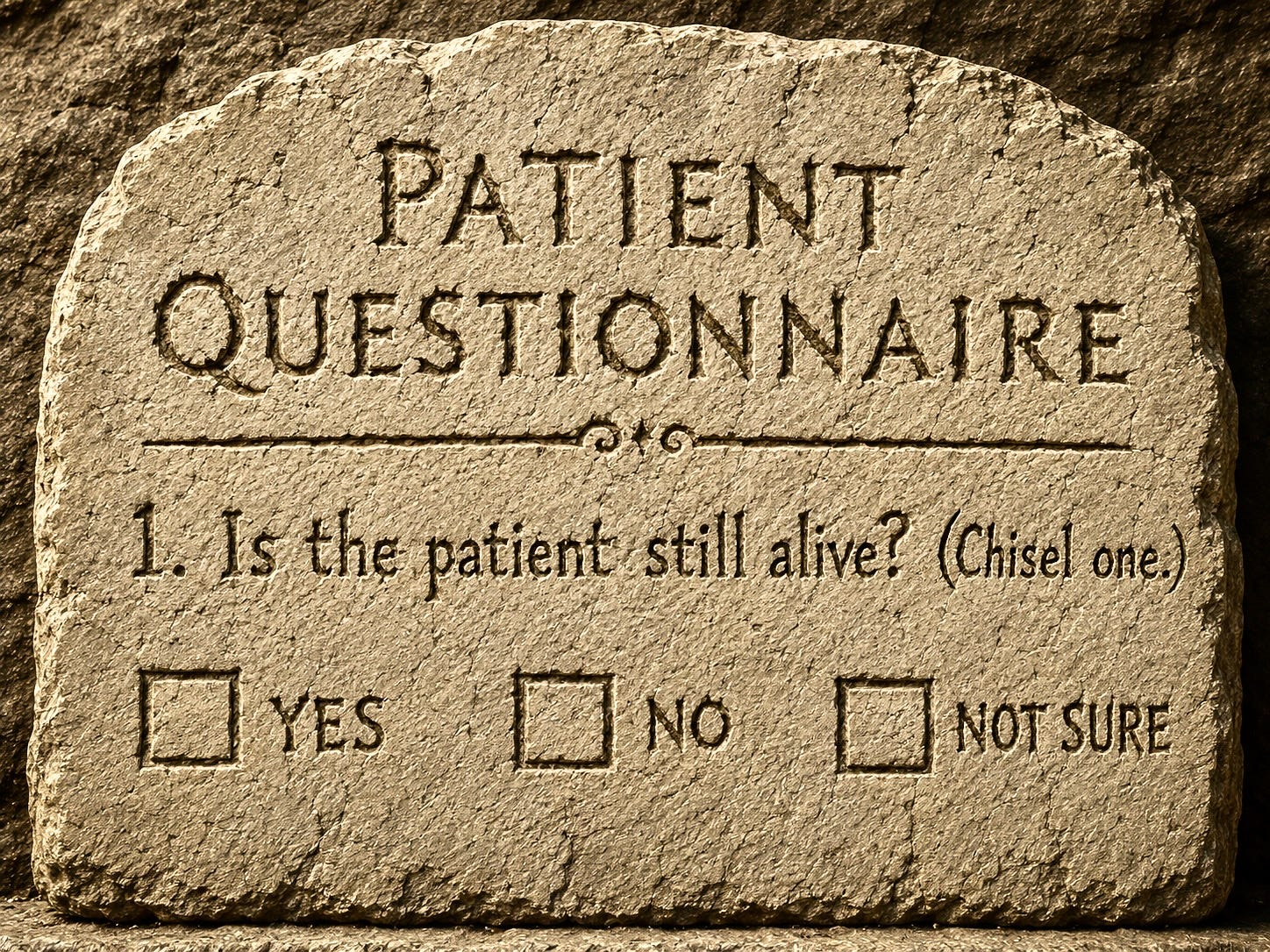
If the patient chiseled “YES” or “NOT SURE,” the standard medical treatment was for the physician to drain the patient’s blood, because in ancient times blood was mistakenly believed to be the leading cause of disease. (We now know that it is actually mucus.) If the patient chiseled “NO,” the physician would still drain the patient’s blood, because in ancient times the physician was also the undertaker.
Contrast that primitive scenario with a visit to a modern medical office, where, before you are allowed to come into direct contact with a doctor for any reason, including to wish him or her a happy birthday, you are handed a clipboard and required to fill out a questionnaire that looks like this:

This questionnaire — which you must fill out completely on every single office visit, even if your previous visit was earlier that same day — requires you try to remember your entire medical history dating back to your birth, including:
Have you ever had mumps?
How many total mumps did you have?
Did you ever have just the one mump?
Filling out this questionnaire can be tedious, but it serves a purpose that is vital to the functioning of a modern medical office, namely, keeping you occupied while you’re waiting three hours or more to see the doctor, who is running behind schedule.
Q. How far behind schedule?
A. The doctor is still in medical school.
IMPORTANT: If you ever, somehow, get to see an actual doctor in person, remember to ask him or her about the prescription drugs advertised on TV. I’m talking about those commercials alerting you to the many, MANY alarming medical conditions that you never heard of before but that you might very well be suffering from, which is why the announcer always instructs you, in an authoritative voice, to “Ask your doctor about (name of drug)!” There are a LOT of these drugs, so to make sure you ask about all of them, you should print out the boldface question below and read it to the doctor verbatim. (All of these are actual TV-ad drug names, which I got from a list maintained by my wife.)
QUESTION TO ASK YOUR DOCTOR:
“Doctor, what about (deep breath) Apretude, Arexvy, Austedo, Biktarvy, Bimzelx, Breztri, Cabenuva, Caplyta, Comirnaty, Cosentyx, Dovato, Dupixent, Emgality, Eucrisa, Farxiga, Fasenra, Humira, Ibrance, Ingrezza, Jardiance, Kerendia, Kesimpta, Keytruda, Kisqali, Latuda, Linzess, Lo Loestrin Fe, Mounjaro, Myfembree, Nubeqa, Nucala, Nurtec ODT, Ocrevus, Opdivo & Yervoy, Opdivo Qvantig, Opzelura, Ozempic, Pluvicto, Qulipta, Quviviq, Reblozyl, Repatha, Rexulti, Rinvoq, Rybelsus, Saxenda, Skyrizi, Sotyktu, Stelara, Taltz, Tepezza, Trelegy, Tremfya, Tresiba, Trulicity, Ubrelvy, Ultomiris, Vabysmo, Veozah, Verzenio, Vraylar, Xeljanz, Xifaxan, Zepbound and Zeposia?”
Unfortunately, your doctor will be unable to answer this question, because he or she is running behind schedule and thus will have exited the examination room somewhere around Pluvicto. This is probably just as well, because for the majority of these drugs the side effects include death.
But my point is that we’re lucky to be living in a modern era when medical science is constantly discovering new diseases for us to suspect that we might have. At the same time, the medical profession is developing exciting new breakthrough procedures for treating patients, such as the one discussed in a recent medical journal article, which I am not making up, with this headline:

This article was brought to my attention by Rob Stavis, who was my roommate at Haverford College, where, on the day he was accepted into medical school, we held a celebration party that culminated with a group of us hanging out in the dormitory showers, fully clothed, with the water running full blast but at a moderate temperature, drinking bourbon from a shoe. (Side Note: I do not recommend this. It makes bourbon taste even worse than usual.)
Anyway, somehow Rob went on from there to become a licensed physician, and although he’s now retired, he keeps up with the medical literature, which is how he stumbled across the Coca-Cola article. In brief, it states that a woman showed up at the hospital with a fecaloma, which is a large hardened mass of poop. (I don’t mean she was carrying it around like a snow globe. It was inside her.) The doctors, after unsuccessfully trying other cures, finally solved the problem by giving the woman two enemas, one liter each, of Classic Coca-Cola. Yes: Coke enemas. Giving new meaning to the slogan “Things go better with Coke.”
It’s not clear how the doctors came up with this idea. Maybe they were having lunch in the hospital cafeteria, trying to figure out what to do about this pesky fecaloma, when one of them happened to take a swig of Coke and let out a loud belch, and the others went: “Bob, that’s IT!” The important thing is, the Classic Coke enema worked, which is great news for massive fecaloma sufferers, of which you could very well be one. Ask your doctor about Classic Coke! You might also want to mention (Why not?) Dr. Pepper.
One final piece of advice regarding modern medical care: If at all possible, you should avoid having to experience it personally. I base this statement on viewing two seasons of the popular TV medical drama The Pitt, which is an extremely realistic portrayal of what happens in a modern hospital emergency room. What happens is, every few minutes a patient arrives in an ambulance, and he or she immediately receives a massive dose of medical care. Here’s a typical Pitt patient being cared for:
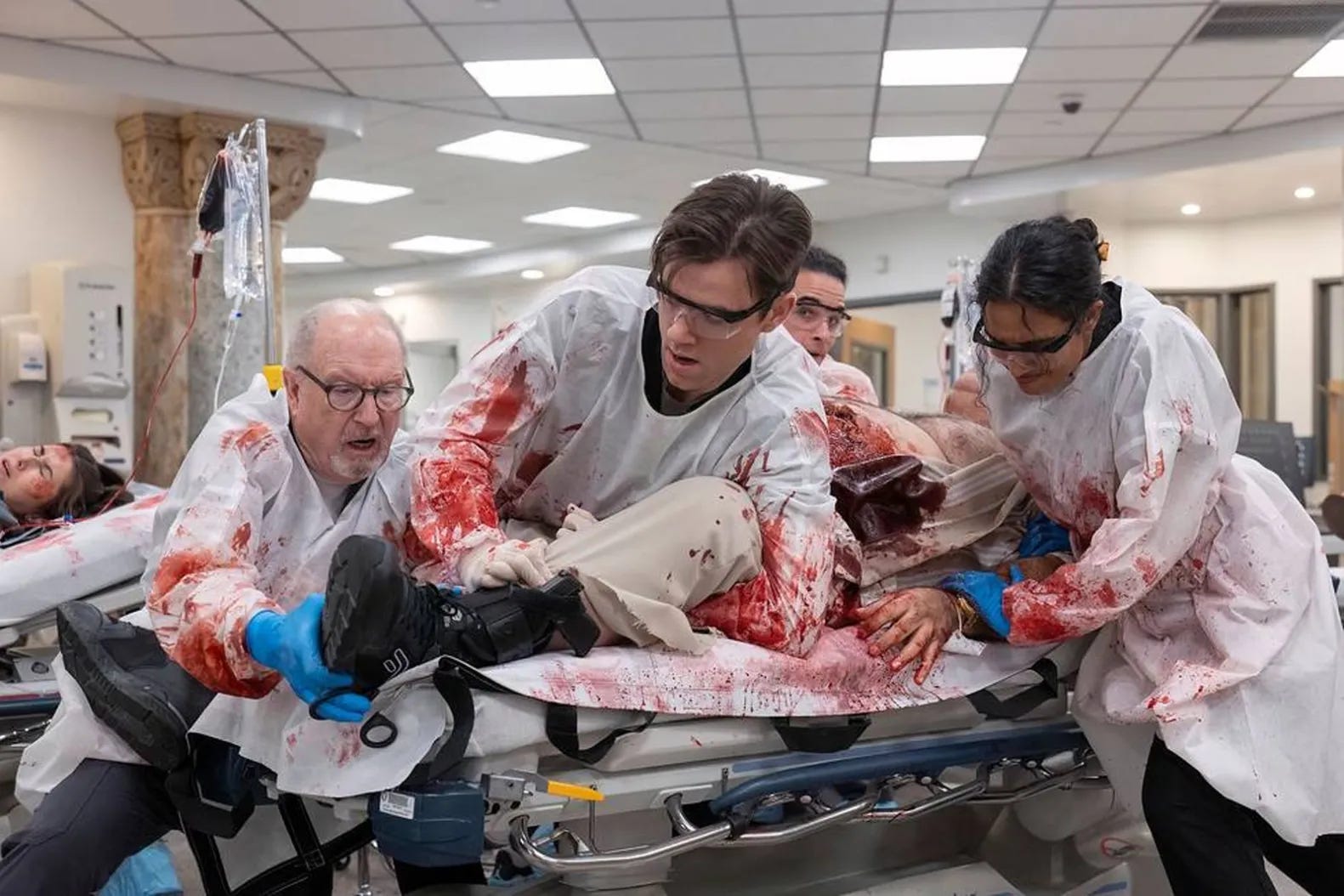
The scary part is, this patient was suffering from hemorrhoids.
No, seriously, The Pitt is a great show, and it reminds us that ER doctors, nurses and staff do a heroic job of providing critical care in an often brutal environment. I don’t know how they do it. As a medical coward, I could NEVER do it. I can’t even look directly at a fictional portrayal of it. I watch roughly 85 percent of The Pitt with my hand over my eyes, so this my view:
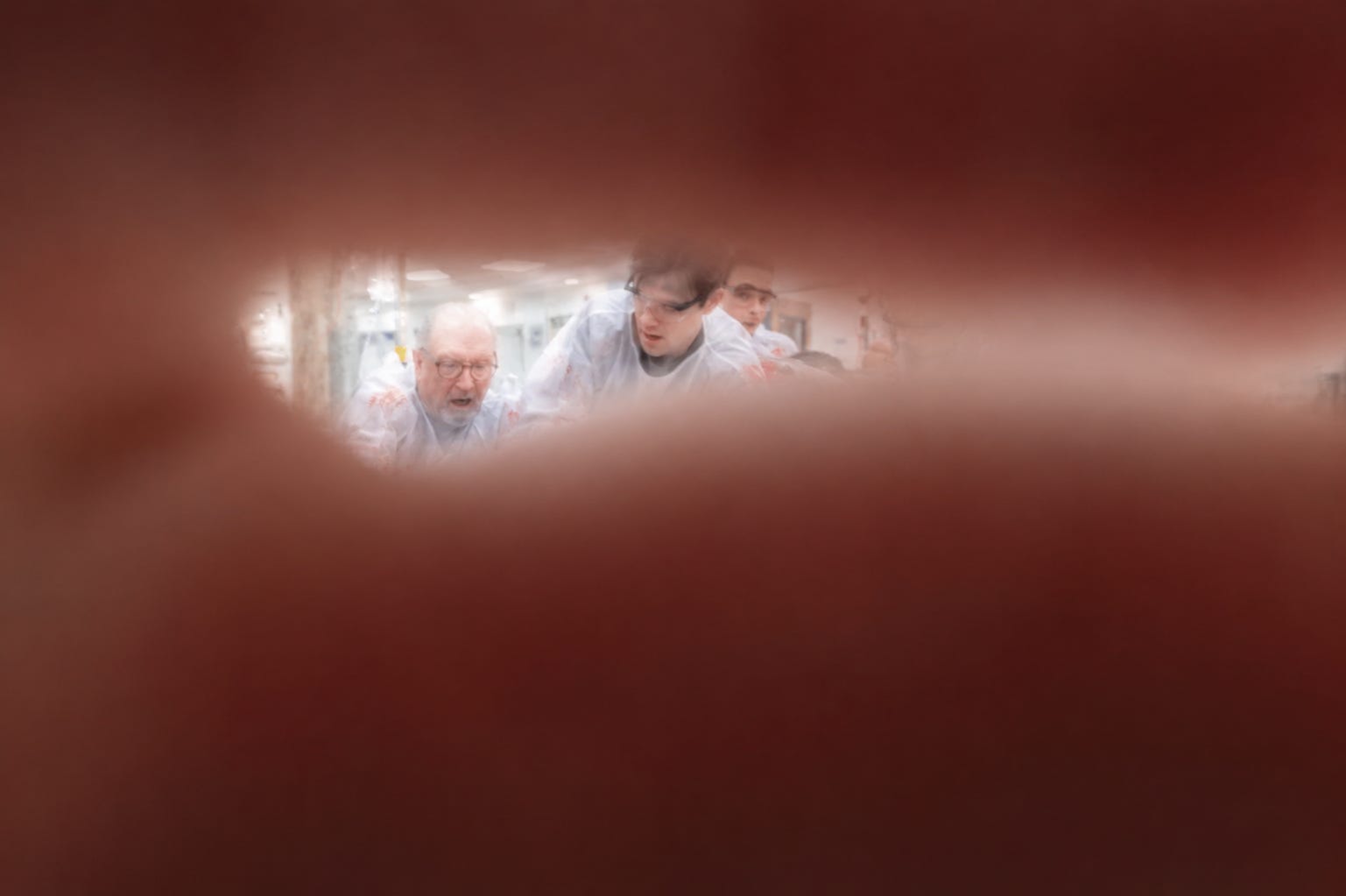
So my hat is off to the ER workers, and in fact to all the members of the medical profession, for the vital services they provide. I’m just saying I’m happier when they’re not providing them to me personally.
But enough about me. Time now to hear — speaking of vital — from you generous paying subscribers, without whom this Substack would not exist. Today we are conducting three scientific polls:
“Fecaloma” is a lovely word — it rolls off the tongue with a slight Italian flair. I almost wish I was young enough to name my baby Fecaloma, or talk someone else into it.
My husband, Mr. Crumpacker, and I think Damnital and Aboveital would be great names for prescription drugs. Fukital. Buggeral. Imagine the ads. “The house is on fire and the cat just had babies, but Mommy doesn’t mind. She’s … Aboveital!”
I'm now so old, I remember when Dr. Pepper was still in medical school.