
Mobile Phones
A Thoughtful Balanced Assessment.

Are mobile phones bad? Or what?
This is a question many leading thinkers are currently thinking about. In an effort to answer it, let’s consider a recent experiment, conducted by university researchers, in which residents of a small coastal California town agreed to give up their mobile phones completely for an entire month.
At first the townspeople, deprived of their “digital crutch,” experienced feelings of emptiness, disorientation and anxiety; they literally did not know what to do with themselves. But after just a few days, guess what happened? That’s right: Their entire town was wiped out by a tsunami, because they didn’t receive the alerts.
What does this experiment teach us? The most important lesson, of course, is that we should never go anywhere near the Pacific Ocean. But it also teaches us that our phones can be a vital information resource. For example, I have an app on my iPhone called “Is it dark outside?” Really. If I want to know whether it’s dark outside, all I have to do is tap this little icon
and instantly the screen displays this reassuring message:

Unless it’s nighttime, in which case the screen says:
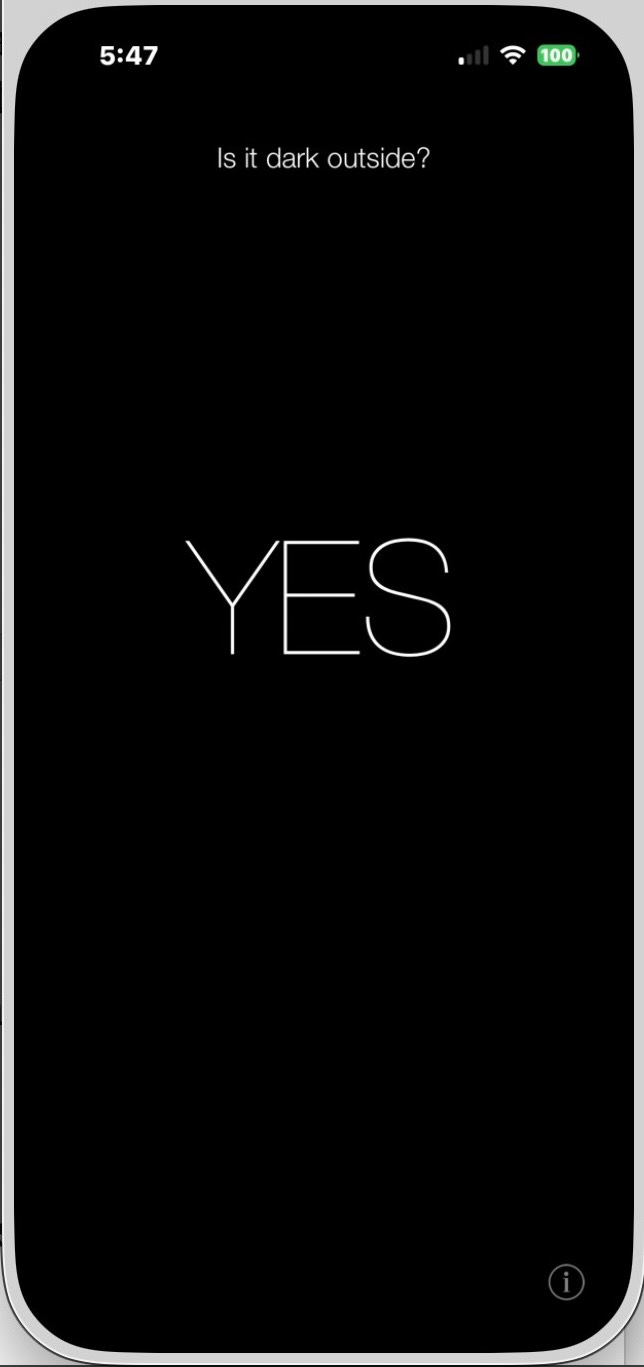
I don’t know how the phone knows this, although I assume it involves an “algorithm.” All I know is, we’ve come a long way since the “bad old days” — you Boomers remember — when we had to manually look out a window to obtain this information.
Speaking of you Boomers: Let’s talk about the need to pee during movies. The question is: When is the best time to go to the restroom without missing anything important? For some movies, by which I mean Cats, the answer is “any old time.” You could schedule a double hip replacement during Cats without missing anything important. But if the movie is, for example, Zootopia 2, which I recently took my grandsons to, and you go to the restroom at the wrong time, you would miss the moment when Judy Hopps and Nick Wilde find out that...
SPOILER ALERT
SPOILER ALERT
SPOILER ALERT
...Pawbert is actually a bad guy. Yes! Pawbert!
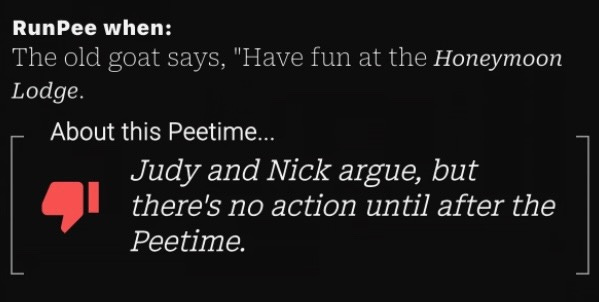
But here’s the thing: You can download an app called RunPee

which lists all the movies that are currently playing and not only tells you exactly when you should head for the head, but also summarizes what happens while you’re gone, as we see in this screenshot:
And here’s the best part: When the movie ends, you can use the “Is it dark outside?” app to find out whether or not, when you leave the theater, you will need to squint.
I think it’s safe to say that back when they invented the internet, Al Gore and Thomas Edison could not have imagined that one day, thanks to their brainchild, we would have this kind of information instantly available at our fingertips. Yet these two apps barely penetrate beneath the surface of the enormous foaming vat of knowledge that, thanks to our phones, we can access anytime and anywhere, making us more productive than we have ever been.
Here’s an absolutely true example of this involving me. Two days ago I was driving on US-1 in Coral Gables, Florida, which means I was essentially parked, because traffic on US-1 moves very slowly.
Q. How slowly does it move?
A. There are still some Conestoga wagons out there.
So while I was sitting motionless, I decided to use the time productively by making a dent in the backlog of unopened emails on my phone, currently estimated at 149 trillion. As it happened, one of the first emails I opened, sent in months ago by an alert Substack reader, contained a link to a news story headlined:

My immediate reaction — I’m sure it was also yours — was: What was a duck doing on a roller coaster? How did it meet the height requirement? But it turned out that, despite the wording of the headline, the woman was the one on the roller coaster. She claimed that a duck flew into its path and hit her in the face, knocking her unconscious. She was suing for $50,000; her lawsuit alleged that SeaWorld was negligent for putting a roller coaster near a body of water that would attract ducks. I am not making this up.
Since my car was still motionless on US-1, I used my phone to Google this case to see if there had been any new developments, and guess what I found out? That’s right: President Trump pardoned the duck.
No, that’s a joke, at least for now. What I found out is that just this week, the woman’s lawsuit was dismissed by a judge after lawyers for Sea World filed a motion asserting that — I am still not making this up — the bird that struck the woman was not, in fact, a duck: It was a snowy egret. (This is what is known in the legal community as the “snowy egret defense.”) According to a legal expert quoted in the story, “the judge ordered that SeaWorld can’t be held responsible for the conduct of a bird flying in the air because it wasn’t foreseeable that they would have known it was there and was actually going to hurt someone.”
This seems fair. It would be a different story if a tourist got attacked by the SeaWorld penguins, who are employed by the park and wear uniforms. But it’s hard to see how SeaWorld can be responsible for the actions of a random wildlife unit. Legally, when we, the members of the park-going public, get on a roller coaster, we knowingly assume the risk that we might collide with an airborne bird, which fortunately is an extremely rare occurrence.
OR IS IT?
I ask this question in large boldfaced capital letters because I decided, since I was still not moving on US-1, to do some further research using AI, which is on my phone as well as probably every other appliance I own including my electric toothbrush, and here’s what I learned:
-- In 2019, a girl riding a roller coaster at Warner Bros. Movie World in Australia was hit by an ibis.
-- In 2017, a man riding a roller coaster at Ferrari Land in Spain was hit by a pigeon.
-- In 2012, a boy riding a roller coaster at Six Flags Great Adventure in New Jersey was also hit by a pigeon (presumably a different pigeon).
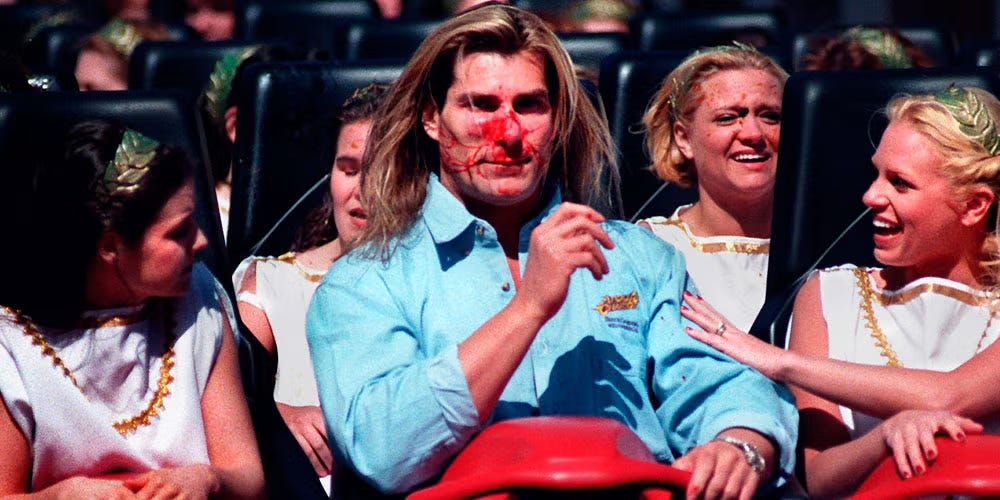
-- In 1999 (you may remember this one) Fabio, the legendary bare-chested romance-book-cover model and stud muffin, was struck in the face by a goose during the inaugural ride of the Apollo’s Chariot roller coaster at Busch Gardens Williamsburg, an event that resulted in the greatest photograph in the annals of stud muffinry:
Clearly there is a pattern here. Am I saying that there is some kind of ongoing international bird conspiracy, involving multiple species, to exterminate the human race one roller-coaster rider at a time? Maybe. Of course not. But what I am saying is that the SeaWorld snowy-egret attack was not an isolated incident. It was part of what we in professional journalism call a “spate.” In fact we might very well upgrade it to an “epidemic,” in which case it would almost certainly be linked — it goes without saying — to global climate change.
But that is not my overall point. My overall point is that I appear to have stumbled across a major news story here, a story that the so-called “mainstream media” missed completely, a story that I think we can all agree is worthy of a major cash journalism prize, and the only reason I got the “scoop” is that while I was stuck in traffic I had my phone with me. So please don’t ask me to jump on the “mobile phones are bad for us” bandwagon. In fact don’t ask me to do anything, because right now I need to figure out why all these cars behind me are honking.
And now let’s hear from you amazing paying subscribers. Today we have two polls:
Brilliant. You make me want to be a writer.
There are true medical conditions for the separation anxiety caused by losing or forgetting your phone. One is called Nomophobia (true story). The other is called Loserdisconnect. In your case it would be Humorinterruptus.