
Aging Well
Apparently I'm not.

So I saw an article in The New York Times headlined:

I am 78 and a half years old. At this stage of my life, my definition of “aging well” is “still not dead.” Nevertheless I was curious to see what trajectory I’m on, so I clicked on the article, which lists four physical tests you’re supposed to take. The first one is called the “Sitting-Rising Test.” Here’s how the Times describes it:
The goal with this assessment is to go from standing to sitting on the floor, and back up again, using the least amount of support as possible. The test is scored on a 10-point scale — five points for sitting down and five points for standing up — and you lose a point for every hand, knee or other body part you use to help yourself. Subtract a half point if you’re unsteady or lose your balance.
The Times quotes the doctor who designed this test (we’ll get to him in a moment) as saying that people in their 30s or 40s should “aim for a perfect 10” on this test, and that a person over 60 who gets an 8 is in “very good shape.”
So my goal was to get an 8, although I would have settled for a 7, or even, given my advanced age, a 6. I took the test in the privacy of my bedroom, going from standing to sitting on the floor, then back to standing again, using as few body parts as possible to help myself. I don’t mean to brag, but on my very first try, with no practice and without warming up, I scored somewhere around minus 137. There was no way I could keep track of the exact number of body parts I used to help myself get down and back up, but it was definitely most of them, including at one point, I believe, my spleen. Also if you count a bedpost as a body part, my actual score was closer to minus 138.
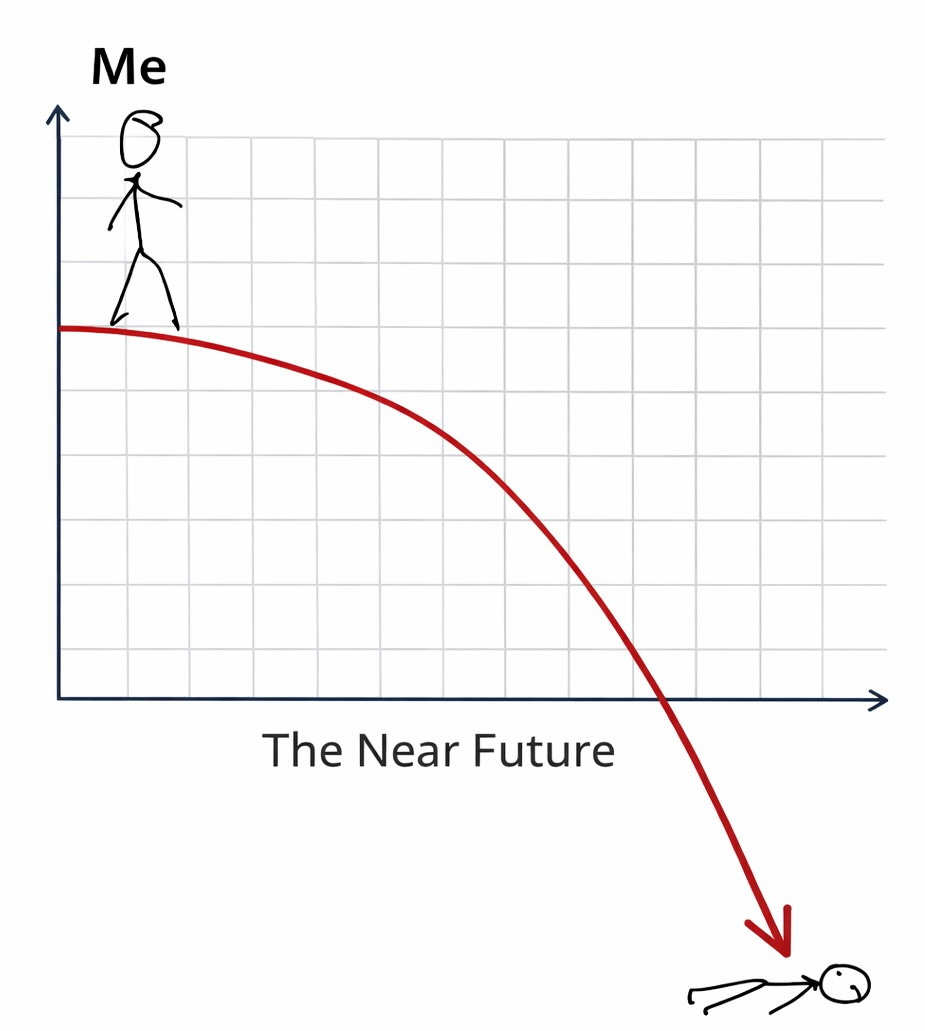
So based on this test, my trajectory was not looking great, as suggested by the following medical chart.
But here’s the thing: I don’t think I ever could have scored a 10 on the “Sitting-Rising Test,” even when I was much younger and fitter and did not have hair sprouting from both ears. In fact I question whether ANY normal non-Olympic-gymnast human could get a 10 on this test. So I did a little research into the man who created it, a Brazilian doctor named Claudio Gil Araújo. Here’s a link to a YouTube video in which he explains the test. For your convenience, I have snipped out a snippet showing the key section wherein, under Dr. Araújo’s supervision, a normalish-looking young man goes, seemingly effortlessly, from standing to sitting, then back to standing, without using any extra body parts:
So this video is proof that a regular human can get a perfect 10 on the “Sitting-Rising Test,” right?
NOT SO FAST. When we analyze this video more closely, we discover something very interesting at the 1:05 mark, as the test subject rises back up. Here’s the freeze-frame:
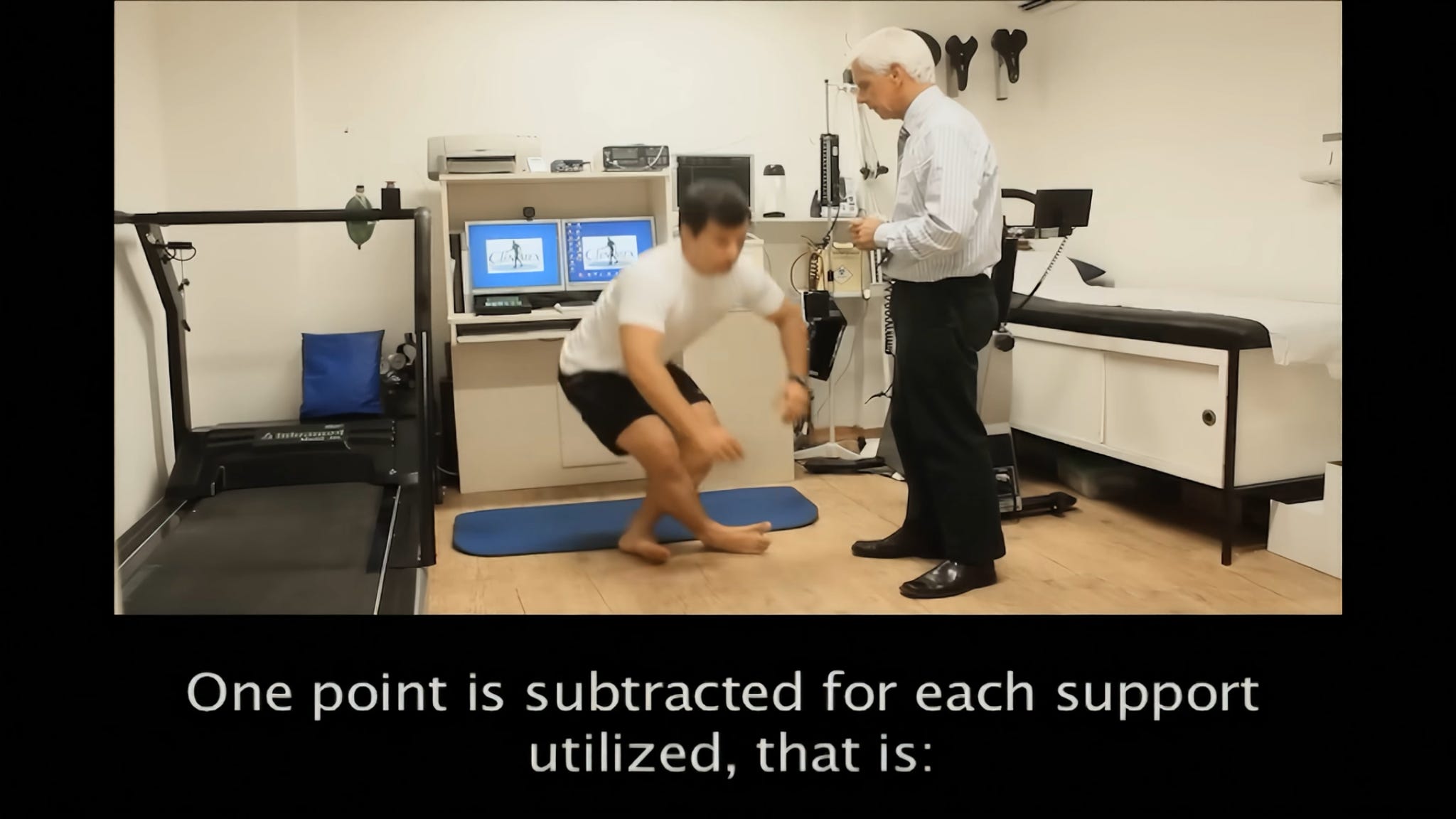
Do you notice something odd? That’s right: When we zoom in, we see that the test subject’s head, which is sharp and clear in the rest of the video, becomes, for a few milliseconds, a blurry, almost shapeless, blob:

What could cause this? I know what you’re thinking. You’re thinking: “Dave, that isn’t ‘odd’ at all! What’s obviously happening is that the strain of standing up is causing the so-called ‘young man’ to momentarily begin de-morphing back to whatever its real shape is.”
Bingo. You are absolutely correct, as we see when we use the power of AI to digitally enhance the blurred image:
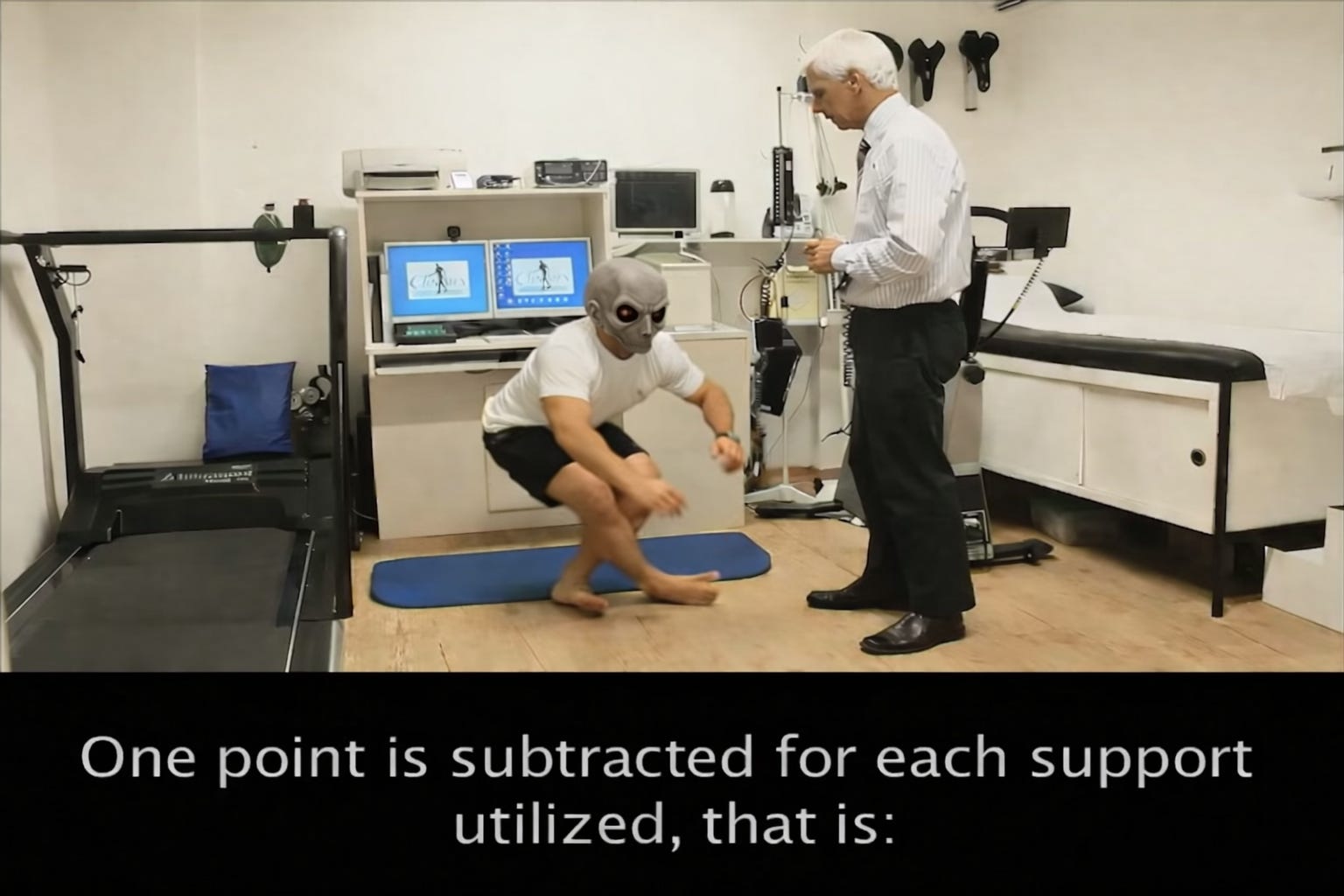
That’s right: Dr. Araújo has designed a “simple aging test” that only space aliens and possibly Simone Biles can pass, and the New York Times totally fell for it. We can only speculate whether there are other examples of extraterrestrial beings posing as humans in our midst that the Times, in its naivete, has failed to detect.


So I decided not to even attempt the remaining three of the Times article’s “simple tests,” which, to judge from the degree of difficulty of the first test, would probably require me to dunk a basketball blindfolded. Although just to confirm that I was not insane, I decided to ask some other aging individuals what they thought of the “Sitting-Rising Test.”
One of these people is my next-door neighbor, Liz, who is my age. When I encountered her, she was outside her house, where she was waiting to talk to some workers who had just arrived in a Florida Power & Light truck. They were here to perform maintenance on our electrical grid, which is the system by which we get electricity into and out of our homes, as explained in this diagram:

HOW THE GRID WORKS: Electricity, in the form of “volts,” flows from the Power Plant through wires to your house, where it goes from the outlet into the toaster and passes through the toast or English muffin before exiting the toaster and making its way, salmon-like, via wires back to the Power Plant, thereby completing an “electrical circuit” and enabling the power company to sell the same volts to you over and over again at an enormous profit.
Florida Power & Light had informed our neighborhood via email that to do their maintenance they needed to turn off our electricity, but they didn’t say exactly when or for how long; Liz was waiting for the workers to get out of the truck so she could ask them. I told her about the “Sitting-Rising Test,” and she decided, while she was waiting, to attempt the test right there on her lawn. She got as far as putting one knee down — which is already a one-point deduction under Dr. Araújo’s scoring system — and wisely elected to bail on the test. I, on the other hand, stupidly decided to take another stab at it, and — there being no bedposts in Liz’s yard — I wound up sprawled face-forward on the grass.
That’s where I was when the supervisor of the Florida Power & Light crew, whose name is Tom, approached us. I briefly explained the “Sitting-Rising Test” to him, and he immediately declined to even attempt it, despite the fact that he’s a mere whippersnapper of 61. “If I got down there,” he said, “I’d never get back up again.”
So the overwhelming consensus of a broad range of older Americans, consisting of me, Liz and Tom, is that the “Sitting-Rising Test” is unrealistic. On the other hand, my wife, Michelle, who turns 61 in a week and is highly competitive, immediately, upon hearing about it, took the test and, with me monitoring her, scored a legit 9 out of 10. Which for me is good news and bad news. The good news is, her health trajectory seems to be excellent. The bad news is, she may eventually decide to return to her home planet.
And now, speaking of weird happenings in the skies, it’s time for a...
KENTUCKY MEAT SHOWER UPDATE
As I reported last week, Kurt Gohde, an art professor at Transylvania University in Kentucky, was planning to re-create the Famous Kentucky Meat Shower of 1876 in Owingsville, Kentucky, last Saturday by having a small airplane drop 1,876 specially wrapped pieces of beef jerky. I emailed Kurt to ask him how it went, and he replied: “People seemed to love the meat rain.” He provided this video, taken by Ruth Adams, showing the plane dumping bunches of jerky as it makes three passes over a clearly delighted crowd:
If this video doesn’t make you feel proud to be both an American and a human being, then I honestly don’t know what would.
Speaking of being an American: This Sunday, remember to set all your clocks either forward or backward by an hour without having the faintest idea why. JUST DO IT, CITIZEN.
And now let’s find out what you always thoughtful and informative paying subscribers have to say.
Boy, after reading the details of the Sitting-Rising Test, I am so glad I died 10 years ago.
MerryCatholic.substack.com
Scientists should also study the Grunt-to-Movement Ratio, which rises dramatically after age 50.