

Modern technology is truly a miracle. A hundred years ago, if you wanted to travel from New York City to Chicago, the fastest way was by train, which took a minimum of 20 hours. Whereas today, thanks to technology, you can simply go to an airport, and in less than three hours you will be notified that your flight has been canceled. This notification will be transmitted at the speed of light via orbiting satellite to an “app” conveniently located right on your phone, a powerful pocket-sized computer that can also tell you when your airline hopes to try to get you on a new attempted flight (maybe sometime tomorrow, but maybe not) and even when you might be able to speak to a human customer-service representative (Halloween).
That’s one of the wondrous things about modern technology: It’s fast. Except of course for the dishwashers. Modern dishwashers — you’ve probably noticed this — take a lonnnggg time to complete a cycle. This is because, in the interest of planetary conservation, modern dishwashers do not use any water. They just make humming sounds for three or four hours, then give up. Basically they’re trying to hum the dirt off your dishes. This is not particularly effective with respect to kitchen sanitation, but we are definitely turning the corner on Global Climate Change™.
But dishwashers aside, modern technology moves lightning-fast. In fact some people think it moves too fast, and they’re trying to slow things down. For an example of this, we turn to recent stories in the New York Times and USA Today concerning two popular new apps, Roost Social and Carrier Pidge. Both of these apps do essentially the same thing, namely, send texts, but — this is the innovative part — they send them very slowly, by pretending that the texts are being carried by birds, as in olden days. I am not making this up. The Roost app lets you choose from a bunch of different kinds of birds, as well as other kinds of carrier animals, including turtles and snails. The Pidge app uses only carrier pigeons, but it has a wrinkle: There’s a small chance that your pigeon will die before it reaches its destination, in which case you have to buy a replacement pigeon for 99 cents. I am still not making this up.
Needless to say I downloaded both of these apps and inflicted them on people I know. Here’s a screenshot of Roost Social on my phone, showing three virtual birds outbound from me in Miami — to Minneapolis, Philadelphia and New York — and one inbound virtual ostrich.
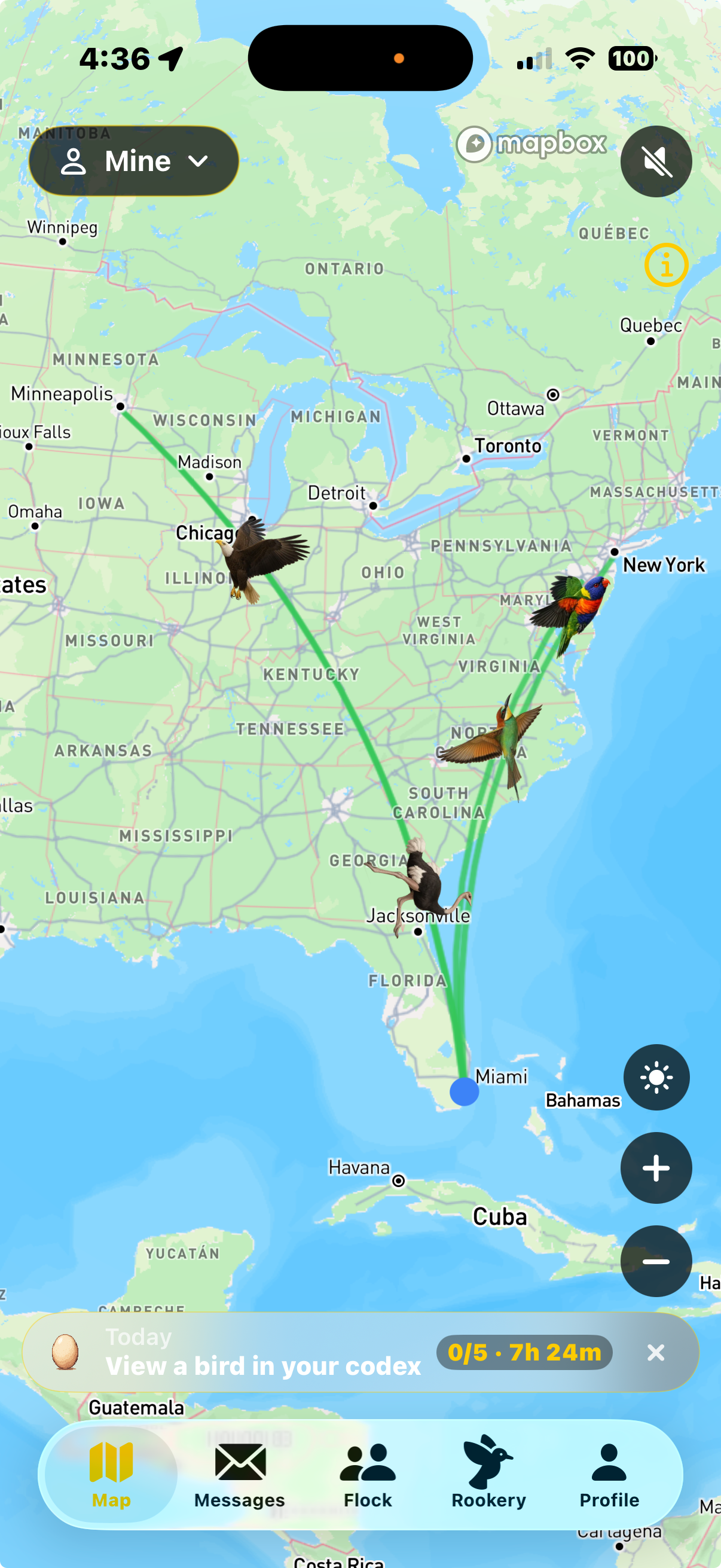
All of these virtual birds took about a day to reach their destinations and deliver the vital information contained in the texts, which was, essentially: “Here is a text.” I also exchanged texts via the Pidge app with my daughter, Sophie, in New York; both of our messages took about ten hours to arrive, and both said, essentially, “I hope this pigeon doesn’t die.”
In other words, these apps are pretty stupid not very practical. Yet hundreds of thousands of people have downloaded them. The question is: Why? Why do people want to deliberately delay the delivery of a message by pretending it’s attached to the leg of an imaginary bird? Are these people six years old?
Emotionally, yes. Not at all! Roost and Pidge are part of a trend called “Slow Tech,” wherein people, mainly Gen Zers, are rejecting technology in favor of a simpler, less-stressful lifestyle. The USA Today article says “more and more young people are turning toward low- or no-tech lives, tired of the endless scroll most of us face for hours each day... It’s no wonder folks are turning to an app that promotes a slower type of communication style.” The Times says that Roost and Pidge “appear to have tapped into a palpable discomfort with screen time and constant communication, and a yearning for an antiquated era.”
As a person who grew up in an antiquated era when we had to change TV channels by manually standing up and turning a knob, I have a couple of thoughts. The main one is that trying to de-technologize your life by using these apps is like trying to get away from the trappings of civilization by escaping to the wilderness in this:

Because you’re still using technology. In fact you’re using it more, because (I speak from experience) after you send a text with Roost or Pidge, you keep checking your phone to see where your imaginary bird is.
Listen, Gen Z: If you really want to get away from screens, why don’t you put down your phones and try writing an actual letter? It’s easy! All you need is a piece of paper, an envelope and a postage stamp, which you can purchase at the Post Office, which is a Soviet-style facility containing a long line of people who have been trying to figure out how to fill out the postal forms since roughly 2017. Also you’ll need to write some words on the paper. AI can help you with that part.
But the real low-tech fun begins when you drop your letter into the mail slot, because after that you have no idea what happens to it. Somehow — maybe it gets attached to the leg of a unionized postal worker — it makes its way to its destination, often arriving in a few days, but occasionally taking weeks or even months, during which it might have had some kind of adventure that, judging from the condition of the envelope, involved an irate raccoon with a stomach disorder. You never know, when you mail a letter. That’s part of the charm.
Another part is that, unlike texts and emails, physical letters usually don’t get deleted. They sit around, maybe for years, ready to be rediscovered. Sometimes they even come back to you, and you can reread them, which is like encountering your past self via a low-tech time machine. Recently my cousin Brian Mark sent me a bunch of letters I wrote in the 1980s to his mom, my late aunt Martha, who lived in California. Here’s one:
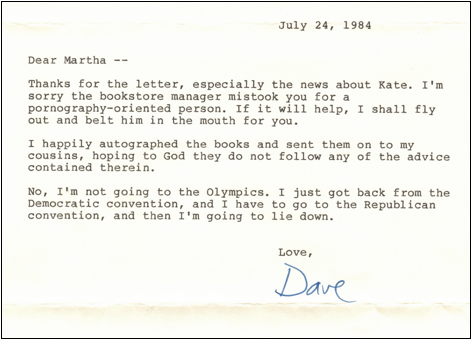
Kate was my big sister, now gone; she was going through a rough patch out in L.A., and Martha was helping her. As I recall, the pornography thing was a reference to a book I’d just written titled Babies and Other Hazards of Sex. Martha wanted to buy copies for her kids, and when she asked the bookstore manager where to find the book, he thought she was looking for porn. Which is pretty funny, if you knew Aunt Martha. That was forever ago, but the memory came right back to me and made me smile, thanks to a letter written by 37-year-old me that I can still physically hold in my 79-year-old hands. So Roost Social and Carrier Pidge can bite me.
No, that’s too harsh. I say this because as I was writing this Substack, I got a phone call from my cousin-in-law Ron Ungerman, who’s one of the people I dragooned into signing up for Roost. Ron, who lives in Minneapolis, is sending a text to my daughter in New York via turtle. He was calling to report that the turtle had just crossed the Minnesota state line into Wisconsin, and is due in New York on September 30. He was very excited about this. The truth is, he was probably deriving as much joy from his imaginary turtle as I was from remembering Aunt Martha’s alleged porno habit.
So modern technology is not entirely bad. It has improved our lives in countless ways, with exciting new innovations coming along all the time, such as the one described in this BBC News article:

That’s right: Some day, in the not-so-distant future, you might be able to have the convenience of a voice-controlled toilet inside your car. The article states that the toilet, as described in the patent, “slides out from the bottom of a passenger’s seat with a push or through voice-activated commands.” Also: “The loo will come with a fan and exhaust pipe to channel odours out of the car.”
Imagine how convenient this invention could be in a scenario such as a commuter carpool that’s running behind schedule:
PASSENGER: Bob, I hate to do this, but can we stop at a gas station? I really have to use the bathroom.
DRIVER: No need for that. (Shouting:) Activate toilet!
(The toilet slides out.)
PASSENGER: Never mind. I’ll just poop my pants.
DRIVER (shouting): Activate exhaust fan!
Yes, the future is looking bright. And now, speaking of bright, it’s time to hear from you brilliant paying subscribers. Today we have three scientific polls:
OMG! These are real apps. I thought Dave was making that sh-- up.
Very excited to try the snail vs. turtle mail. Hope to still be here when my text from DC gets to my brother in California.